7 Setlist Mistakes Cover Bands Make (and Fixes)
Most bad sets are not bad because the songs are bad. They are bad because of a handful of structural mistakes that are easy to make and easy to fix once you can see them. Here are the seven we see most often, and what to do instead.
The short version
- Front-loading your strongest song leaves the rest of the night downhill.
- Tempo and vocal effort are different things, and confusing them wears out your singer.
- A set you can see as a shape is far easier to fix than a list of titles.
1. Firing your best song first
It is tempting to open with the number that always lands. The problem is what comes after. If song one is the peak, every song that follows is a small disappointment, and the room feels it even if nobody can say why. Open with something recognisable and up, but keep your biggest gun for the back half where it can lift a tiring crowd.
A good opener convinces the room the night is in safe hands. It does not have to be the best thing you do all evening.
2. Treating tempo and vocal effort as the same thing
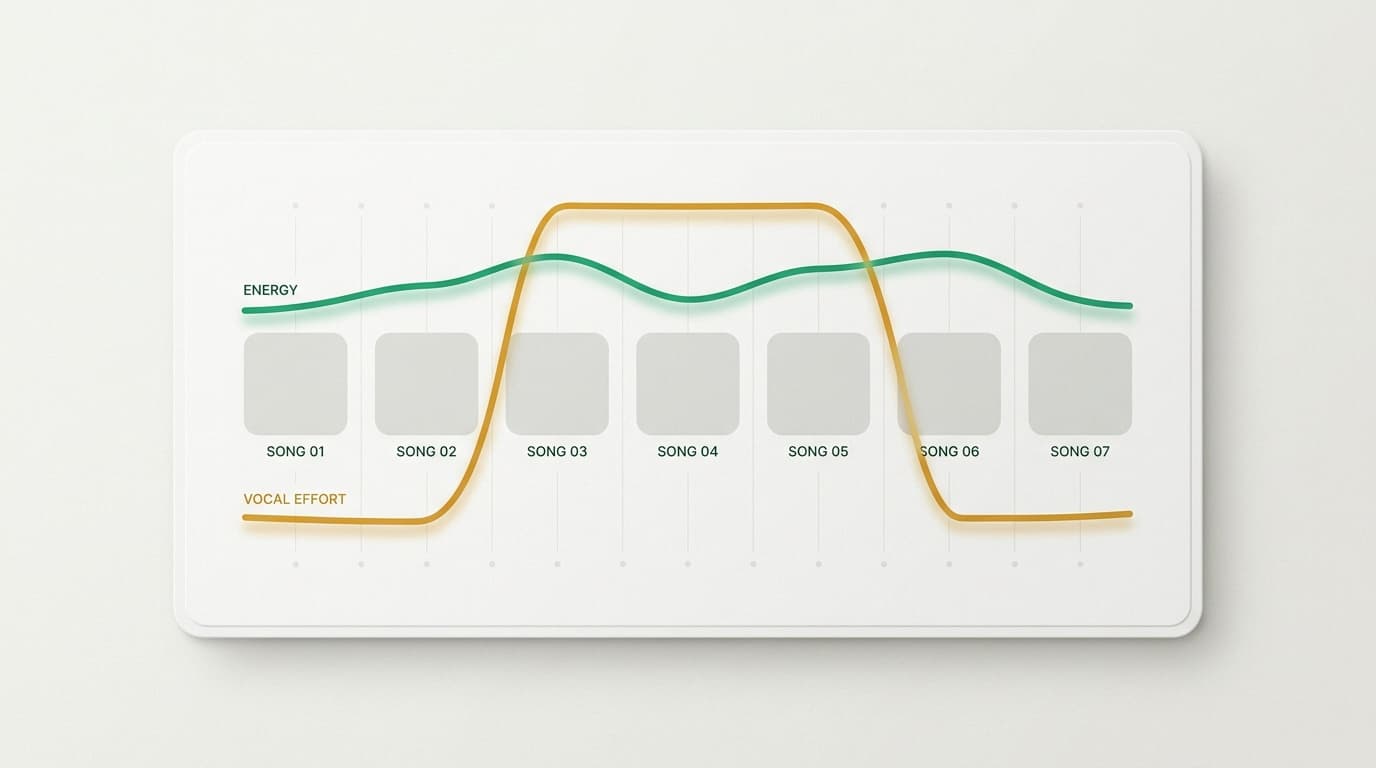
Fast does not mean hard to sing, and slow does not mean easy. A quiet ballad that sits at the top of your singer's range is far more demanding than a driving rock number they can belt in their chest voice. Bands that only plan by tempo end up stacking three vocally brutal songs in a row without noticing, and the singer is shot by the second set.
Rate each song for vocal effort separately from its energy. Then keep a simple rule: no more than two demanding vocal songs back to back, with a lighter, lower number in between to let the voice recover. The crowd hears variety. Your singer gets a breather.
3. Three mid-tempo songs in a row
Each song can be good on its own and the run still dies. Three songs at the same feel and tempo flattens a room because nothing is changing. The fix is contrast: follow a groove with a singalong, follow a singalong with something that drives. You are looking for a small lift or shift every couple of songs, not a flat plateau in the middle of the set.
4. Building a playlist instead of a set
A playlist is songs you like in an order that feels nice. A set is a deliberate arc that carries a room from the first downbeat to the last chord. The difference is intent. Before you pick songs, decide what each set has to do: a pub residency wants steady energy from song one, a wedding wants a slow build to a packed floor, a support slot wants to grab people fast and never let go.
When you can see the set as a curve rather than a column of titles, the flat spots and the pile-ups become obvious. That is the whole reason Set List Creator draws the energy of a set as a line above the song list.
5. Ignoring the key changes between songs
This one is a finishing touch, not a deal-breaker, but it separates a tidy band from a great one. Songs in clashing keys back to back can feel jarring, and a hard tonal jump kills the momentum you just built. Where it is easy, order songs so neighbouring keys are compatible. DJs lean on the Camelot wheel for this. You do not need to obsess over it, just avoid the obvious clangers.
6. Playing the same set every week
If you hold a residency, the regulars notice when nothing ever changes. They will not complain, they will just stop turning up. Rotate. Rest the songs you have leaned on and bring back ones you have parked. You do not need a new set every week, you need enough turnover that a regular hears something different month to month.
Tracking what you played and when is the hard part by hand. Apps that weight song choice by how recently you played it solve this quietly, surfacing rested songs first when you auto-build a new set.
7. Leaving the charts on someone's laptop
The set is only half the job. If your dep guitarist cannot find the chart for the one song they do not know, the planning was wasted. Keep charts, keys and notes attached to the songs themselves, and make sure everyone in the band can pull them up on their own phone before the gig, not in the car park ten minutes before the first set.
Put it together
None of these fixes is complicated. The trouble is holding all of them in your head at once while you also pick songs you and the crowd actually want to hear. That is exactly the kind of bookkeeping software is good at: pacing the vocals, watching the energy, remembering what you played last time, and keeping the charts where the band can reach them, so you can spend your attention on the music.
Frequently asked questions
- How many songs should a cover band setlist have?
- Plan for roughly 15 to 18 songs per 60-minute set at an average of three to four minutes a song, then add one or two spares in case the night runs long or a song gets cut. Build to time rather than to a fixed number, since ballads and extended jams change the maths.
- What is the biggest setlist mistake?
- Treating tempo and vocal effort as the same thing. It is the error that does the most damage, because it wears out your singer halfway through the night without anyone realising why the second set sounds tired.
- Should the strongest song go first or last?
- Last, or close to it. Open with something recognisable and up to win the room, then hold your most reliable floor-filler for the back half where it can lift a crowd that is starting to flag.
About the author
The Set List Creator team
Written by the people who build Set List Creator, most of whom play covers, function and wedding gigs around New Zealand. The advice here is the same thinking baked into the app.